
Back to all blog posts

Every benefits line item eventually lands on a finance leader's desk with the same question attached: what are we getting for this? For a lifestyle spending account (LSA), "employees love it" won't survive a budget review. You need numbers.
The challenge is that LSA ROI has two halves. The hard-dollar half shows up directly in your costs: unspent funds, retired vendors, and hours your team gets back. The soft-dollar half shows up in retention, engagement, and how employees value their total rewards. Finance will trust the first half faster, but the second half can carry the bigger return.
Utilization ties the two together. Across Benepass programs, LSAs average 83% utilization, according to the Benepass 2026 Benchmarking Report. That figure drives your cost model and signals whether employees value the benefit enough to use it. This guide walks through a three-part framework for calculating lifestyle spending account ROI, then breaks down every input you'll need.
You don't need a consultant to build this business case. Run these three steps with your own payroll, vendor, and HR data:
The Hard ROI and Soft ROI sections below supply the inputs for steps one and two.
Start with the four hard ROI line items: forfeited funds, consolidated vendor fees, admin time saved, and any tax-advantaged categories. Then subtract what the LSA platform costs.
Here's a simple example for a 500-person company offering an $800 annual LSA (the median broad LSA contribution in the 2026 Benchmarking Report), compared against paying the same amount as a taxable payroll stipend:
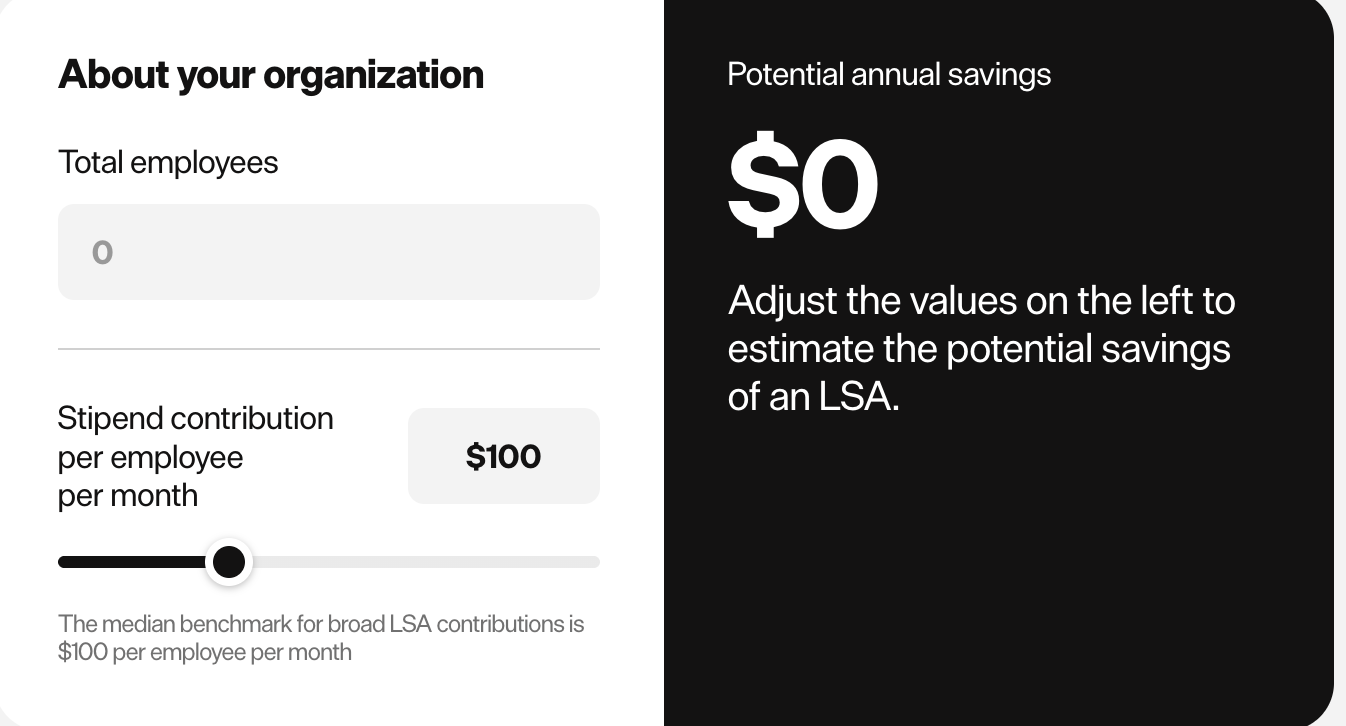
That's $79,460 in net hard-dollar savings, or about $5.52 for every $1 spent on platform fees. To run the numbers for your own company, enter your headcount and monthly allowance in the Benepass LSA ROI calculator. It models expected spend, unused funds, payroll tax savings, and platform fees against a cash stipend. Its defaults differ slightly from the example above, so use your own contribution and utilization figures. However you run the numbers, present the result against the alternative you'd otherwise fund (cash stipends or separate vendors), since that's the comparison finance will make.
Keep the math simple and the assumptions conservative. Retention is the easiest soft driver to translate into dollars:
Soft-dollar value = departures prevented × average cost of turnover
Using the same 500-person company with 15% annual turnover, you'd expect 75 departures a year. If the LSA helps retain just three of those employees, and each departure costs an average of $45,236 according to Express Employment Professionals and The Harris Poll, the program preserves $135,708.
Be explicit that "three departures prevented" is an assumption. After the first year, replace it with real data by comparing retention among LSA participants against non-participants.
A strong ROI figure means little if the program behind it is underperforming. Compare your utilization rates against benchmarks for your LSA type.
Median utilization varies widely by design, per the 2026 Benchmarking Report:
If your utilization sits well below the benchmark for your category, don't count the extra unspent funds as a win. Low usage inflates forfeiture savings while shrinking the soft-dollar impact, which usually points to unclear rules, too much friction, or a category that doesn't match employee needs. If you're above the benchmark, your soft ROI case is stronger, since employees are clearly using what you fund.
Hard ROI covers quantifiable metrics like cost savings and time saved. These are the inputs for Step 1, and the numbers finance will want front and center.
An LSA only costs money when employees use it. You don't pay out funds until an employee makes an eligible purchase, so any allowance employees don't spend stays with your company unless your policy lets it roll over.
Compare that with adding the same amount to paychecks. Payroll stipends leave the business in full whether or not employees use them for the intended purpose, and they carry employer payroll taxes on every dollar.
If your company runs separate programs for fitness, professional development, work-from-home equipment, and meals, each one carries its own fees, contracts, and invoices. An LSA folds these into one flexible account with one vendor to manage. Consolidation also tends to lift usage: LSAs see 75% to 85%+ engagement, compared with 10% to 15% for most point solutions, according to the 2026 Benchmarking Report.
To quantify the savings, total the annual fees for your current point solutions and compare them against the cost of a single platform. Our guide to choosing LSA vendors covers what to ask about pricing during that comparison.
Manual reimbursements eat HR and finance time: chasing receipts, approving claims, and reconciling payroll. With a card-first approach like the Benepass LSA, employees pay with a Visa card and transactions are checked against your policy in real time at checkout. Reimbursements for out-of-pocket spend are reviewed against the same rules. After switching to Benepass, Trupanion cut LSA administration costs by 67% compared with its previous vendor.
To assign a dollar value, audit how many hours your team spends each week on expense review and vendor management. Multiply by your team's average hourly cost, then estimate the hours an automated platform would remove.
Most LSA spend is taxable income to employees. According to IRS Publication 15-B, any fringe benefit is taxable unless the law specifically excludes it. Some LSA-eligible expenses can qualify for an exclusion when the program is set up correctly:
For employees under the Social Security wage base, every excluded dollar avoids the 7.65% employer share of Social Security and Medicare taxes, and employees keep the full value. You'll need documentation for each use case, so confirm the setup with your tax advisor. Card transaction data and receipt records from your LSA platform provide that audit trail. For fully pre-tax options, see how modern pre-tax spending accounts compare.
Soft ROI covers impact on recruiting, retention, engagement, and culture. These drivers are harder to measure, but they supply the inputs for Step 2 and can outweigh the hard savings.
Benefits carry real weight in whether people stay. In WTW's 2024 Global Benefits Attitudes Survey, 54% of employees said benefits were a reason they stayed with their employer, and 76% said their benefits met their needs when they had the most choice.
That second figure matters for LSAs, which are built around choice. When employees can direct funds toward what they need, the benefit feels personal, which gives them one less reason to shop for a better package elsewhere.
Perceived value is how employees judge a benefit's worth, independent of its dollar amount. Compare giving employees $100 a month for wellness with a $1,200 annual bonus.
The monthly allowance is a recurring reminder that the company supports their wellbeing, with money set aside specifically for a yoga class, therapy session, or massage. The bonus often disappears into groceries and bills without registering as a benefit at all. Same cost, very different perceived value.
Employees look at benefits to judge whether a company's stated values are real. An LSA shows trust: you set the guardrails, and employees decide what's best for them.
You can also use an LSA to support specific populations, such as a family care benefit covering childcare, fertility, adoption, or surrogacy. LSAs also let you extend the same support to remote teams and satellite offices that HQ employees get, which is a core strength of a flexible benefits scheme.
Healthcare costs keep climbing. The KFF 2025 Employer Health Benefits Survey put average annual premiums at $9,325 for single coverage and $26,993 for family coverage.
A wellness-focused LSA gives employees dedicated funds for gym memberships, fitness equipment, health apps, meal kits, and mental health support like meditation apps or online therapy. Dedicated funds make healthy habits easier to keep. Still, treat healthcare savings as a long-term, conservative input, since the research on wellness programs and medical costs is mixed.
Engagement is where soft ROI connects most directly to business results. Gallup's meta-analysis of employee engagement found that top-quartile business units achieve 23% higher profit than bottom-quartile units.
A benefit employees use every month is a visible signal that the company invests in them. When you present to leadership, pair your utilization data with engagement survey results to show that connection.
The framework above gives you what you need to build the business case: a hard-dollar total finance can audit, a soft-dollar estimate with clear assumptions, and benchmarks that show whether the program is healthy. Once you have leadership approval, launching an LSA with Benepass takes four steps:
If you're moving from existing stipends or point solutions, our guide to transitioning to an LSA covers how to plan the switch.
Book a demo to see how a card-based Benepass LSA tracks utilization, keeps unspent funds with your company, and cuts manual reimbursements, so the numbers in your business case hold up after launch.
LSA ROI includes hard-dollar savings (retained unspent funds, payroll taxes avoided, consolidated vendor fees, and admin time saved) and soft-dollar value (reduced turnover, stronger recruiting, and higher engagement). Most HR teams lead with hard savings and treat soft value as upside with stated assumptions.
Wellness program ROI has traditionally focused on healthcare cost reduction, and the evidence there is mixed. A 2024 University of Oxford study of 46,336 UK workers found no evidence that individual-level interventions like mindfulness classes improved wellbeing. LSA ROI rests on firmer, faster-moving inputs: budget control, vendor consolidation, utilization, and retention. For measurement approaches beyond cost, see our guide to measuring employee wellbeing.
Hard-dollar savings show up in the first plan year: unspent funds return to the company as each funding period expires (depending on your rollover policy), and retired vendor contracts drop off at renewal. Soft-dollar returns take longer. Plan on at least 12 months of retention and engagement data before comparing participants with non-participants.
