
Back to all blog posts

American workers forfeit billions of dollars in unused FSA funds every year. Money magazine's 2025 analysis, drawing on Employee Benefit Research Institute (EBRI) data, estimated $4.5 billion in 2023 alone. For HR leaders, that number represents a real challenge in benefits design and communication. When employees don't understand the accounts available to them, they under-contribute, miss deadlines, and lose money they could have saved on taxes.
Choosing between a health savings account (HSA), flexible spending account (FSA), or both affects employee utilization, your organization's tax efficiency, and how much administrative work your team carries throughout the year. This guide gives you the clarity to design and communicate the right program for your workforce.
Both HSAs and FSAs are employer-sponsored, pre-tax accounts that help employees pay for qualified medical expenses, but they differ significantly in eligibility rules, contribution limits, and how unused funds are handled. Choosing the wrong account type, or failing to explain the differences clearly, can lead to low participation, forfeited funds, and frustrated employees.
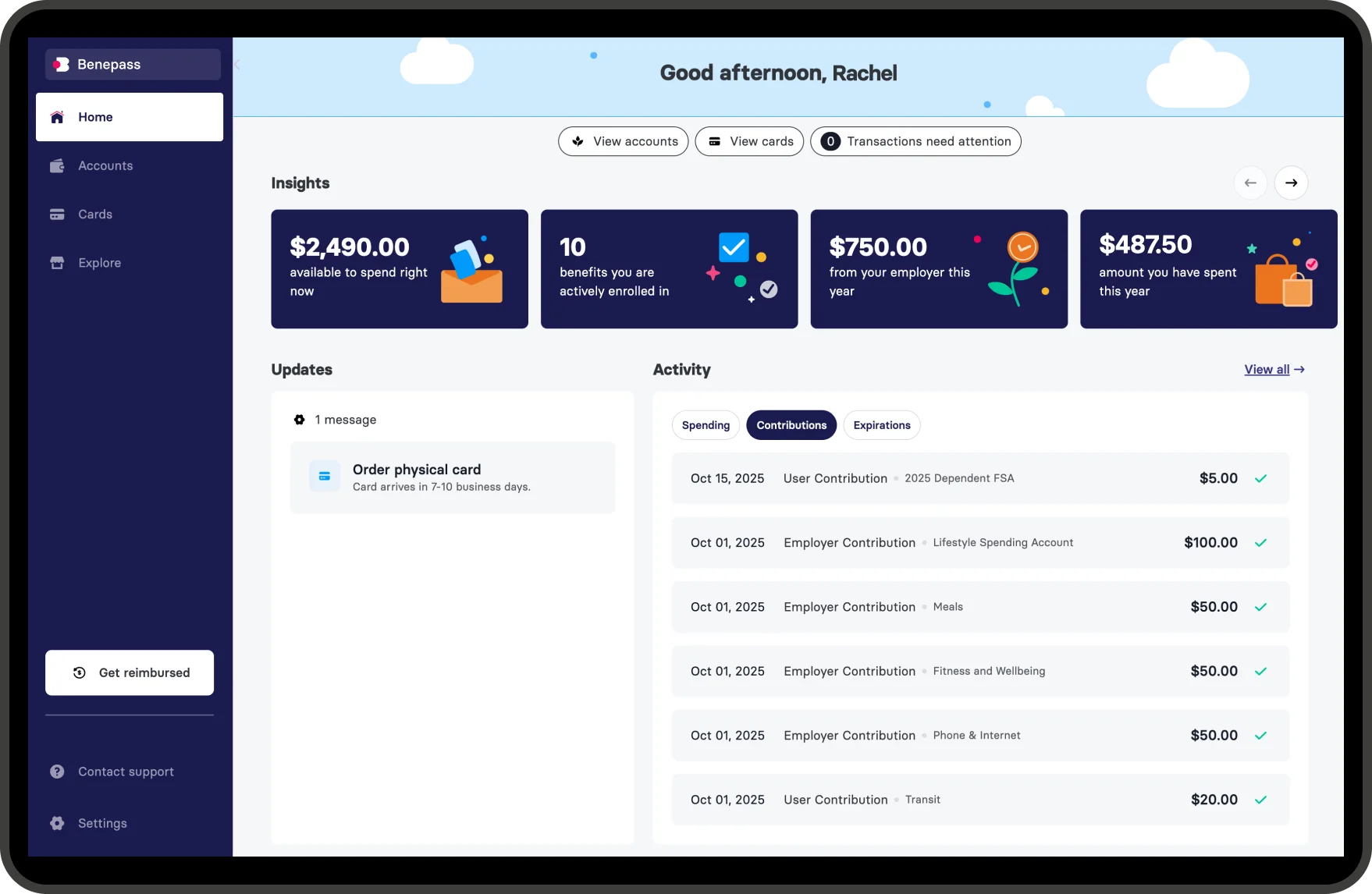
Benepass supports both HSAs and FSAs on a single platform and card, giving you one system to configure account rules, set contribution limits, and manage compliance, while employees get one place to track spending across all their pre-tax accounts.
An HSA is a tax-advantaged savings account employees can use to pay for qualified medical expenses. To qualify, an employee must be enrolled in a high-deductible health plan (HDHP) that meets IRS minimum deductible and out-of-pocket requirements. For 2026, that means a minimum deductible of $1,700 for individual coverage or $3,400 for family coverage.
HSAs offer a triple tax advantage: contributions go in pre-tax, funds grow tax-free through interest or investment, and withdrawals for qualified medical expenses are tax-free.
Key HSA eligibility requirements:
HSA funds roll over year after year with no deadline, and the account belongs to the employee, so they keep it if they leave your organization. For 2026, contribution limits are $4,400 for individual coverage or $8,750 for family coverage, with an additional $1,000 catch-up contribution for those 55 and older. Employer contributions count toward these annual limits.
HSAs work best for employees who can manage higher deductibles and want to build long-term healthcare savings. The portability and HSA investment options make them particularly valuable for employees planning ahead for future medical costs.
An FSA is an employer-sponsored, pre-tax account that lets employees set aside paycheck dollars to cover eligible healthcare or dependent care expenses. Unlike HSAs, FSAs are available to any employee whose employer offers the benefit. There's no requirement to be enrolled in a specific type of health plan.
For 2026, employees can contribute up to $3,400 to a healthcare FSA and up to $7,500 per household to a dependent care FSA, following the One Big Beautiful Bill Act's increase from the long-standing $5,000 cap. One defining feature of FSAs is the "use-it-or-lose-it" rule: Employees must spend their funds within the plan year, or they forfeit any unused balance. You can soften this by offering a grace period (up to 2.5 months after the plan year ends) or allowing a carryover of up to $680 from a 2026 plan year into 2027, but you can only choose one of these options.
Healthcare FSAs follow the uniform coverage rule, meaning the full annual election amount is available to employees on day one, even if they haven't yet contributed the full amount through payroll. Dependent care FSAs work differently: employees can only access funds up to what they have actually contributed at the time of the claim.
Because FSAs don't require HDHP enrollment, they're often the more accessible option for employees on traditional preferred provider organization (PPO) or health maintenance organization (HMO) plans.
FSAs are employer-owned accounts, which means you control the plan design but also carry the compliance responsibility.
Running an FSA also means managing plan documents, tracking contribution limits, processing claims or card transactions, and handling year-end reconciliation. Benepass reduces this load by letting you configure FSA rules once, and then handling card controls, transaction processing, and compliance reporting across your workforce.
HSAs are employee-owned accounts, which shift much of the administrative burden away from your team.
In most cases, no. The IRS treats a general-purpose FSA as "other health coverage," which disqualifies an individual from making HSA contributions, even if they're enrolled in an HDHP.
The exception is a Limited Purpose FSA (LPFSA), which restricts reimbursements to dental and vision expenses only. Because it doesn't provide first-dollar medical coverage, it doesn't disqualify HSA eligibility. Employees can contribute to an HSA for long-term savings while using an LPFSA to cover predictable dental and vision costs like orthodontia, glasses, or contact lenses.
Pairing the two is also the dominant pattern among HSA-offering employers. According to Benepass's 2026 Benchmarking Report, 61% of employers offer an HSA, and 84% of those also offer an LPFSA for dental and vision expenses.
This matters most for HR leaders managing mixed health plan populations. If your organization offers both HDHP and non-HDHP plans, you'll likely need to administer multiple account types: employees on the HDHP can contribute to an HSA (and optionally an LPFSA), while employees on traditional PPO or HMO plans can participate in a standard healthcare FSA.
Platforms like Benepass simplify this by letting you configure eligibility rules once and automatically applying the right account access based on each employee's health plan enrollment.
Your health plan design determines which pre-tax accounts your employees can access.
When you frame account type as a function of plan design during open enrollment, employees understand why they're being offered an HSA or FSA, and confusion drops significantly.
Once you've decided which account types to offer, determine how much you'll contribute and how you'll help employees make the most of their benefits.
Your contribution approach directly affects both your benefits budget and participation rates. Options include:
Many employers use HSA contributions as a recruiting and retention tool, particularly when pairing HDHPs with meaningful seed funding. For FSAs, employer contributions are less common but can be a differentiator, especially for dependent care FSAs where employees face high out-of-pocket costs.
Even a generous contribution strategy falls flat if employees don't understand how to use their accounts. Your education plan should cover:
Consider offering contribution calculators, comparison charts, and one-on-one benefits counseling sessions. For educating employees on pre-tax benefits, build your communication plan around the specific account types you're offering and the questions your workforce is most likely to ask.
Yes. HSA funds roll over completely from year to year with no expiration. FSA funds operate under a use-it-or-lose-it rule by default: employees forfeit unused balances at the end of the plan year unless you offer a grace period of up to 2.5 months or allow a carryover of up to $680 for 2026 plan years. You must choose one option; you can't offer both. For more details on what happens to FSA and HSA accounts at year-end, review IRS guidance and share it with employees before the spending deadline.
It depends on the FSA type. If the spouse has a standard healthcare FSA that covers general medical expenses, the employee can't contribute to an HSA, even if they're enrolled in a qualifying HDHP. The IRS treats the spouse's FSA as disqualifying coverage because it can reimburse medical expenses for the entire family. However, if the spouse has an LPFSA covering only dental and vision expenses, or a dependent care FSA, the employee can still contribute to their HSA. During open enrollment, educate employees about spousal FSA interactions. Many don't realize their spouse's election can affect their own HSA eligibility until it's too late to correct for that plan year.
Both account types cover the same core list of IRS-qualified medical expenses: doctor visits, prescription medications, dental care, vision care, mental health services, and most over-the-counter medications. The IRS maintains Publication 502, which defines the full list. The key difference in the HSA vs. FSA comparison isn't what's eligible, but how the accounts function. For HR teams, this means your communication strategy should focus less on eligible expense lists and more on helping employees understand which account to use first. Pointing employees to unexpected FSA-eligible items can also help drive utilization and reduce year-end forfeitures.
The HSA vs. FSA decision comes down to a few core distinctions: HSAs require an HDHP and offer portability, investment options, and unlimited rollover. FSAs work with any health plan but forfeit unused funds at year-end unless you offer a grace period or carryover. Your health plan lineup drives which accounts your employees can access, and your workforce demographics should shape how you contribute and communicate.
If you're managing a mixed population, such as some employees on HDHPs with others on traditional plans, you'll likely need to offer both account types or add an LPFSA to support HDHP participants who want additional pre-tax coverage for dental and vision. That's where platform design becomes an operational advantage.
Benepass gives HR and benefits teams one platform to deliver HSAs, FSAs, LPFSAs, and other pre-tax programs under a single card experience. You configure the rules once, and the platform handles card controls, transaction processing, and account tracking across your entire workforce. Employees get one card, one login, and one place to manage their pre-tax spending.
Learn how Benepass supports pre-tax HSA benefits and FSA benefits, helping employees understand and use their accounts with confidence.