
Back to all blog posts

Most HR professionals and leaders design their benefits program based on informed guesses. They look at what similar companies offer, listen to a handful of vocal employees, and assume the rest of the workforce feels the same way. That gap between assumption and reality shows up later, in low utilization numbers and in turnover you didn't see coming.
An employee benefits survey closes that gap. It gives you a direct, structured way to find out what your team actually values, what they're not using and why, and where your next dollar of benefits spend will have the biggest impact. Below, you'll find 20 questions to include in your next survey, organized by category, plus a free template and a framework for turning results into action.
An employee benefits survey is a structured feedback tool HR leaders use to assess employee satisfaction with current offerings, surface unmet needs, and prioritize changes before the next open enrollment. It's narrower and more decision-focused than a general employee engagement survey, which measures how people feel about their job, their manager, and the company overall. A benefits survey asks one question set: Is what we're paying for actually working for our people?
That distinction matters because the two surveys often reveal different things. A team can report high engagement while still being dissatisfied with health coverage, confused about pre-tax accounts, or unaware of perks they're already eligible for. According to a 2025 Prudential study reported by WorldatWork, 86% of employers believe they provide modern, competitive benefits, but only 59% of employees agree. A benefits-specific survey is how you find out which side of that gap your organization actually falls on.
An annual cadence, timed a few months ahead of open enrollment, is the standard approach. That timing gives you enough runway to analyze results, adjust plan design, and communicate changes before employees make their elections. Beyond the annual survey, run one whenever:
A mid-year pulse survey is also worth building into your calendar. It's shorter than the full annual version, but it can catch a utilization problem, like low enrollment in a new benefit or confusion about a plan change, before it turns into an open enrollment headache.
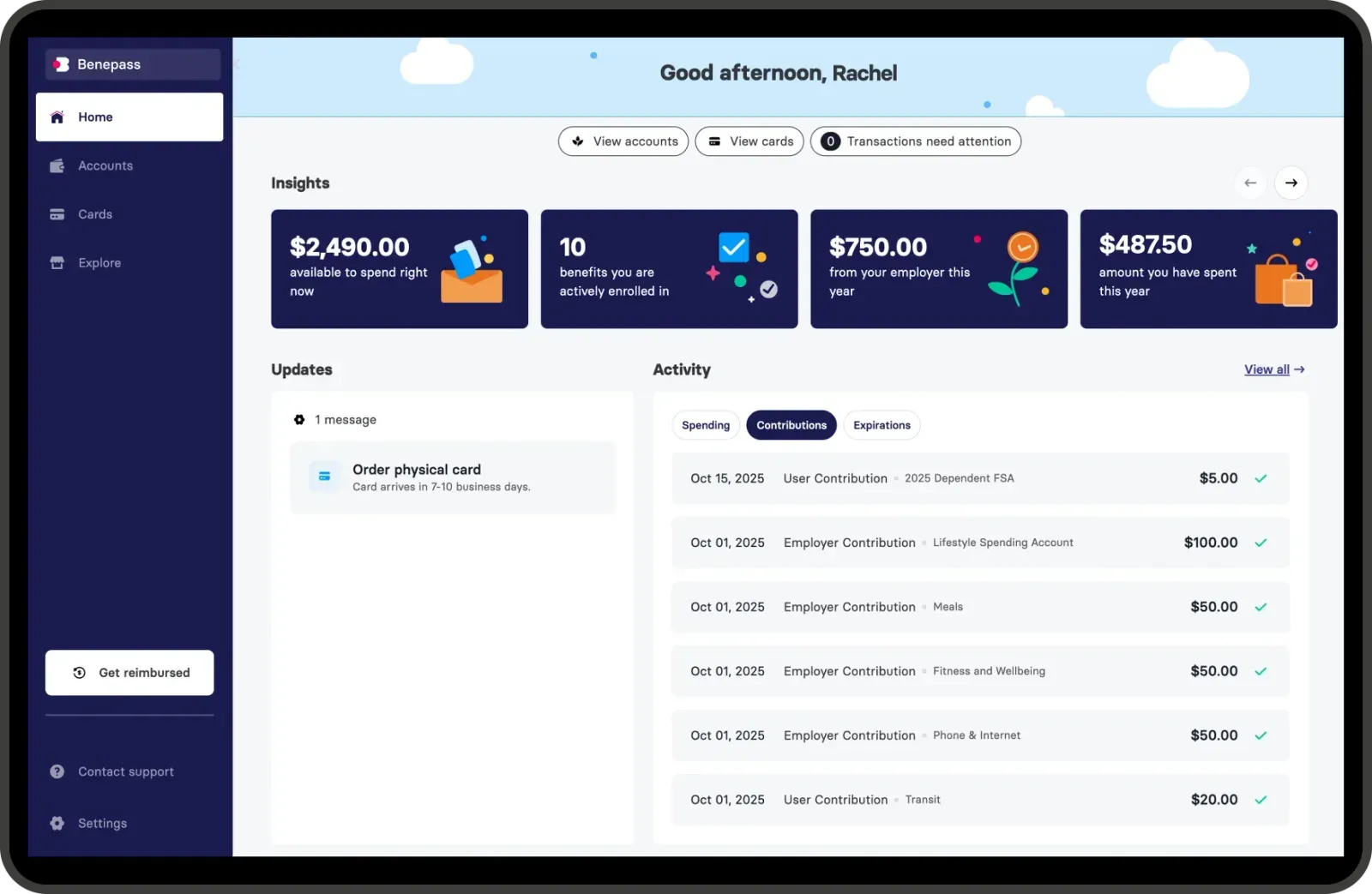
A strong benefits survey balances breadth with focus. Twenty well-crafted questions, organized into four categories, give you enough coverage to act on without exhausting your respondents, whether your current lineup is a traditional package or one of the more flexible benefits plans gaining ground. Use a five-point Likert scale ("strongly disagree" to "strongly agree") for satisfaction questions and open text for the qualitative ones.
Question 8 matters more than it might look. According to Benepass's 2026 Benefits Benchmarking Report, 21% of employers have employees who forfeit money from their HCFSA, with an average forfeiture of $265 among those who do. That's a concrete dollar amount tied to a problem this survey question can help you find and fix.
That range is exactly why question 14 belongs in your survey. Benepass's 2026 report shows median LSA utilization by category running from 92% for entertainment down to 30% for mental health. A gap that wide usually points to friction or low awareness, not disinterest, and the redesign question above is how you find out which one you're dealing with.
That trade-off question in the priorities section is worth building into every survey. External research consistently shows that employers and employees rank benefits differently. The 2025 SHRM Employee Benefits Survey shows this tiering even among employers themselves. Health care, retirement, and paid time off top the list of what employers rate as extremely or very important (88%, 81%, and 81%, respectively), while flexible work, family care, and professional development trail behind at 68%, 67%, and 65%. If your own survey data shows employees ranking work-life balance benefits above the traditional trio, that's a real signal worth acting on: a mismatch between what your organization prioritizes and what your workforce actually values.
You don't need custom survey software to run a solid benefits survey. The 20 questions above translate directly into a template you can build in Google Forms, SurveyMonkey, or whatever tool your organization already uses:
Keep demographic questions (tenure, department, location) optional and clearly explain how responses will be used, especially if you're promising anonymity. That transparency tends to drive higher completion rates than the survey questions themselves.
Collecting responses is the easy part. The value of a benefits survey comes from what happens next, and a lot of surveys stall out right at the analysis stage because "share findings with leadership" isn't actually a plan. Build a more specific process instead:
The survey is the input. Your benefits design is the output. It's tempting to treat the survey as the finish line, but data without action erodes the trust you just spent time building, and employees who took the time to answer honestly expect to see something change.
That's usually where the friction shows up. A survey might tell you employees want more flexibility in family care benefits and less redundancy across three separate point solutions, but implementing that insight can mean rebuilding significant parts of your benefits strategy from the ground up, especially if your current programs are locked into rigid vendor contracts.
Benepass gives HR teams a single platform for pre-tax accounts and lifestyle spending accounts, built for exactly this problem. When your survey results point to a new priority, whether that's expanding a wellness category, adding a family-formation benefit, or simplifying a confusing FSA process, you can adjust the program directly instead of sourcing, contracting, and onboarding an entirely new vendor. The next time you run your benefits survey, you'll be measuring the impact of changes you were actually able to make, and the employee retention that follows from them.
Take a look at what's configurable on the Benepass pre-tax and lifestyle spending account platform before your next planning cycle. Book a demo to see how it works.
