
Back to all blog posts
12 Affordable Employee Benefits Employees Will Actually Use


HR leaders are being asked to do more with the same benefits budget, sometimes less, while employee expectations for meaningful perks keep climbing. Private employers spent an average of $14.01 per hour worked on benefit costs in March 2026, or about 30% of total compensation, according to the Bureau of Labor Statistics. Every dollar needs to work harder, which is why affordable employee benefits packages matter so much right now.
Sticker price is only part of the affordability question. A benefit that costs very little but sits unused still costs money without delivering value, while a benefit with real budget behind it can pay for itself many times over if employees use it.
The list below includes some of the least expensive benefits available today, along with a look at how employers are folding uneven-use benefits into a single lifestyle spending account instead of managing each as its own low-usage vendor.
A cost-effective benefit delivers a measurable return, in retention, utilization, or reduced absenteeism, relative to what it costs to fund and administer. That return shows up in three places HR leaders can measure:
Utilization is where benefits programs quietly lose money. According to the 2026 Benepass Benefits Benchmarking Guide, employees engage with lifestyle spending accounts at a rate of 75% to 85% or more, compared to 10% to 15% for many traditional point solutions. Two benefits can cost the same amount per employee and land in very different places on a return basis, simply because one gets used and the other doesn't.
Perceived value follows a similar pattern: the highest-rated benefits in employee surveys aren't always the most expensive ones. Flexibility and personalization tend to matter more to employees than price, which is why several items below lean toward benefits employees can shape around their own lives for a steadier work-life balance, including flexible work arrangements.
See our guide on benefits benchmarking to learn more.
These 12 benefits range from ones that cost close to nothing to ones with defined budgets and specific tax treatment, including what each typically costs, who values it most, and where it fits in a modern benefits stack.
Letting employees choose when and where they work costs little beyond systems you likely already have. Compressed workweeks, flexible work schedules, and remote or hybrid arrangements rank near the top of what employees value in flexible benefits plans. The direct cost is close to zero, but the retention impact isn't: employees trusted to manage their own schedule have greater job satisfaction.
Paid time off (PTO) counts as a labor cost more than a distinct benefits expense, since employees get paid whether they're in the building or not. Expanding it, including dedicated volunteer hours, tends to lower unplanned absenteeism, since employees take planned breaks instead of calling out. Volunteer time also gives employees a sense of purpose that shows up in employee retention over time.
Many employers use this category to consolidate spend instead of adding another line item. A lifestyle spending account (LSA) is an employer-funded stipend employees can put toward non-medical lifestyle expenses, such as fitness, continuing education, childcare, or a home office setup, based on categories the employer defines.
LSA dollars are taxable, so the account skips the plan-design and nondiscrimination rules flexible spending accounts (FSAs) and health reimbursement arrangements (HRAs) carry, and unused funds typically don't roll over, keeping the annual cost predictable. That structure shows up in the numbers: LSAs see 83% average utilization, according to the 2026 Benepass Benefits Benchmarking Guide, well above what most single-purpose point solutions manage.
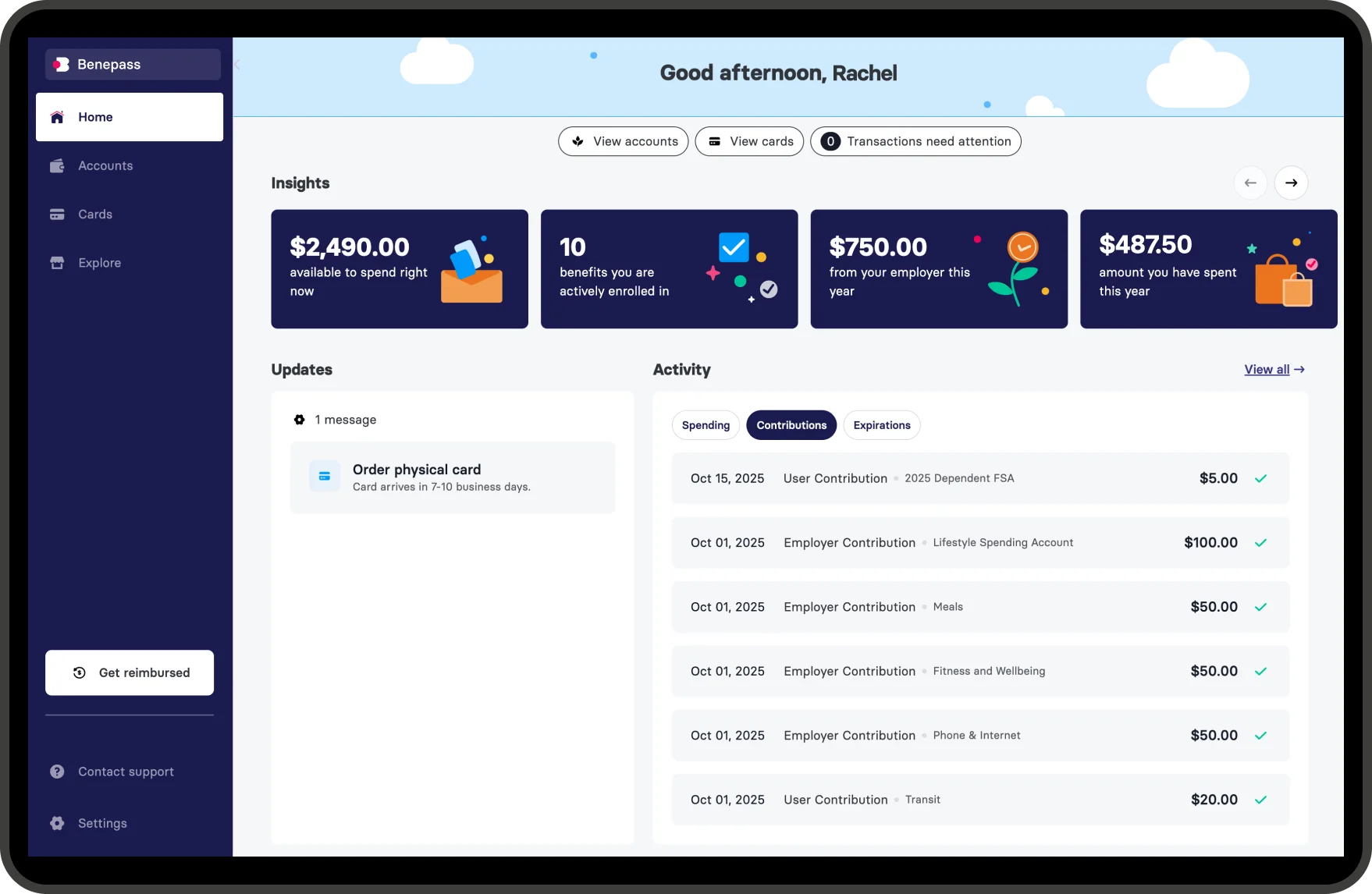
The bigger shift is what LSAs replace. Benefits like wellness discounts and financial coaching often get purchased as separate point solutions with separate vendors and low utilization numbers. Routing that budget through one LSA with configurable lifestyle benefit categories gives employees one place to spend and HR one program to manage instead of five.
Commuter benefits let employees pay for transit and parking pre-tax, lowering their taxable income and your payroll tax base at once. For 2026, the IRS caps the pre-tax exclusion at $340 per month each for transit and parking, combined participant and employer contributions, per IRS Publication 15-B. That makes this one of the few benefits here with a direct payroll tax offset, administered simply through a dedicated commuter benefits program.
A dependent care FSA lets employees set aside pre-tax dollars for childcare, preschool, or elder care, and costs little to administer relative to the tax savings it delivers. Starting in 2026, the annual limit rises to $7,500 for joint filers, or $3,750 filing separately, up from $5,000, under the One Big Beautiful Bill Act, per the text of the legislation.
Healthcare FSAs and health savings accounts (HSAs) let employees pay for medical expenses pre-tax, lowering out-of-pocket costs without changing what your health plan itself costs. Employers save on FICA taxes for every pre-tax dollar contributed, often covering most or all of the administration fee. Consolidating HSAs, FSAs, and HRAs on one platform makes that savings easier to track.
Employers can provide up to $5,250 per employee per year in tax-free educational assistance under Internal Revenue Code Section 127, a limit the IRS confirmed remains in place for 2026. That covers tuition, certifications, and, following a recent legislative change, student loan repayment through the same program. Some employers fund this as a standalone stipend, while others route it through an LSA category, and it’s worth weighing against the pros and cons of a lifestyle spending account if you already manage several stipend types.
Employee assistance programs (EAPs) typically cost $12 to $40 per employee per year and cover mental health counseling, financial counseling, and legal support in one program, according to a 2026 guide to EAP costs. That is broad coverage for a low price, but EAPs also illustrate the utilization problem this article opened with: usage often stays under 10% without active promotion. Some employers now fold this kind of support into an LSA category instead, since funds sitting next to money employees are already spending tend to get noticed more.
Financial wellness benefits now cover more ground than a one-off workshop, including one-on-one financial planning, employer-seeded emergency savings accounts, and student loan repayment assistance. Since 2024, employers have also been able to match retirement plan contributions based on qualified student loan payments under SECURE 2.0, per IRS guidance. Because these tools tend to get adopted piecemeal, this is another category that often ends up LSA-eligible rather than its own vendor relationship.
A 401(k) match signals that you're investing in employees for the long term, and the cost is predictable because you set the formula. A modest match, such as 50% up to 4% of salary, costs far less than a dollar-for-dollar match while still giving nearly every participating employee some employer money in their account. Vesting schedules add a retention mechanism by design, since employees who leave before vesting forfeit part of the match.
Gym and wellness discounts work best when they reward participation rather than subsidizing a membership no one uses. Negotiated corporate rates, class packages, and wellness app discounts fall into this category, and programs tied to actual attendance see meaningfully higher use than a flat subsidy.
This is exactly the kind of spend employers pull into an LSA instead of a standalone gym contract: one flexible stipend covers several of these options and gives HR one utilization number to watch instead of five. See our list of employee perks that don't require a large budget.
A one-time or annual stipend for software, hardware, or productivity tools shows employees you're investing in how they work, without the ongoing cost a monthly subsidy would carry. This matters most for distributed teams, where a laptop stand, a second monitor, or a home office upgrade directly affects how well someone can do their job. Like the wellness and financial categories above, this often runs through an LSA rather than a separate stipend program, so the eligible-category list can flex without a new vendor contract each time.
Once you know which benefits are on the table, the harder question is which combination fits your workforce and budget. Four steps help:
That work gets harder when every benefit lives on a different vendor with its own reporting. Benepass gives HR leaders utilization data and configurable benefit categories, including pre-tax accounts and lifestyle spending accounts, on one platform, so you can see what’s working and adjust without a new vendor for every benefit type.
If you want to see how a single platform can lift utilization, cut the number of vendors you manage, and give employees one place to spend, book a demo with Benepass.
